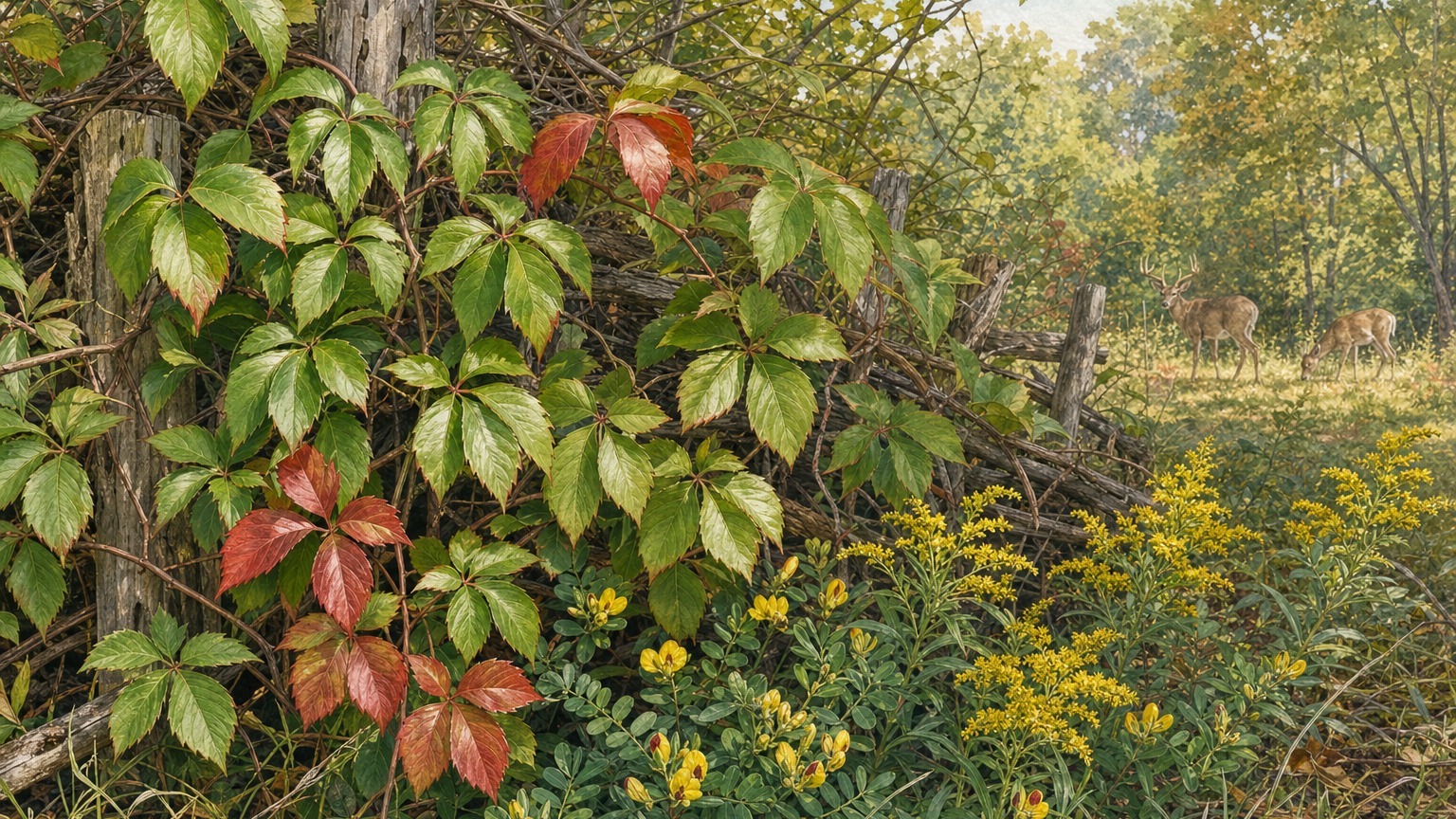
Plant guide
Parthenocissus quinquefolia
A vigorous Virginia-native vine for woodland edges, fence lines, and sacrificial deer corridors. It climbs, sprawls, roots along edges, feeds birds with berries, turns brilliant red in fall, and can absorb browse pressure where a wild buffer is welcome.
Choose a place where vigor is an asset. Virginia creeper does not need rich vegetable-bed soil; loosen a small planting pocket, add leaf mold if the edge is compacted, and keep mulch away from the crown until it establishes.
Water deeply every week during the first summer. After establishment, it usually survives on rainfall in Central Virginia except during severe drought on exposed slopes.
Skip fertilizer. Rich feeding makes the vine harder to control and less useful as a low-input edge plant.
Train new growth onto fences, brush piles, or sacrificial trellises. Prune away from buildings, gutters, young trees, and the protected garden side before tendrils harden.
Do not harvest for food. Leave berries for birds and use pruned vines as brushy habitat or chop-and-drop mulch away from paths.
Goldenrod is listed as a useful companion for Virginia Creeper; use it to build a more resilient mixed planting instead of treating this as a single-crop bed.
Common milkweed is listed as a useful companion for Virginia Creeper; use it to build a more resilient mixed planting instead of treating this as a single-crop bed.
Partridge Pea is listed as a useful companion for Virginia Creeper; use it to build a more resilient mixed planting instead of treating this as a single-crop bed.
Blackberry is listed as a useful companion for Virginia Creeper; use it to build a more resilient mixed planting instead of treating this as a single-crop bed.
Kale is listed as a useful companion for Virginia Creeper; use it to build a more resilient mixed planting instead of treating this as a single-crop bed.
Use these as decision points for a mixed bed: choose companions that solve a real job for this planting, such as support, pollinator draw, soil cover, pest confusion, or harvest timing.
Watch out for these common pests and diseases. Early detection and prevention are key to maintaining healthy plants.
Treat Virginia Creeper as one role in a working plant team. These guild pages show the full recipe, timing, nearby plants, and failure points around this crop.
| Issue | How to fix it |
|---|---|
| Vine climbs where it is not wanted | Cut young runners monthly during the growing season and redirect growth to rough fencing or brush piles. |
| Deer strip young plants | Plant several starts in the outer barrier and protect one or two crowns with temporary cages until rooted. |
| Confused with poison ivy | Virginia creeper usually has five leaflets; poison ivy has three. When in doubt, identify before handling. |
Best for native habitat, wildlife forage, and tough edge coverage.
Useful for larger restoration-style plantings in Virginia.
Plant details were checked against regional/native plant references before publication.
Use it as one layer in a darker, softer, lower-spray yard that supports fireflies and the insects they depend on.
