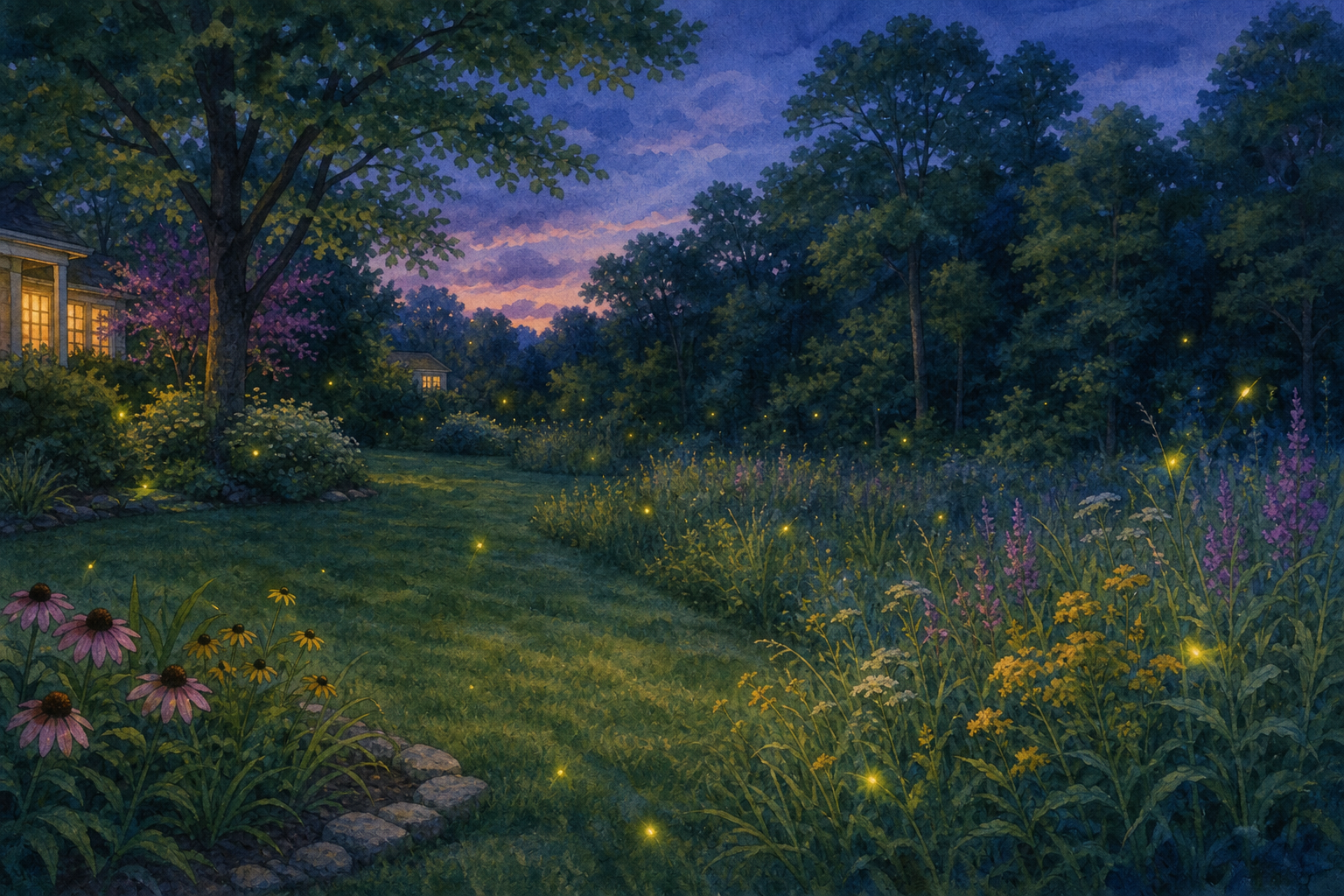
How to Build a Lightning Bug Habitat in Mechanicsville and Central Virginia
Learn how to attract lightning bugs in Central Virginia with darker nights, no-spray lawn care, leaf litter, less mowing, damp habitat edges, and Virginia native plants.
If you grew up around Richmond, Mechanicsville, Ashland, or the rural edges of Hanover County, summer did not feel fully switched on until the first lightning bugs blinked above the grass.
This guide is for Central Virginia homeowners who want that back without turning the yard into a high-maintenance native plant fantasy. The recipe is simple: darker nights, no spray, less mowing in the right places, damp soil, leaf litter, logs, and Virginia native plants.
Start small: protect one 10-by-20-foot edge for a month before buying anything. Turn the lights down, stop spraying, mow a clean border, keep some leaves and logs tucked back, then watch what happens at dusk.
Quick answer: how to attract lightning bugs in Central Virginia
To attract more lightning bugs in a Mechanicsville or Central Virginia yard:
- turn off unnecessary outdoor lights during summer evenings
- stop using broad-spectrum insecticides in the habitat zone
- mow selected edges less often, but keep a clean border
- leave some leaf litter, logs, and damp ground-layer shelter
- add Virginia native plants for shade, moisture, structure, and insect life
You do not need a pond, a full meadow, or a messy-looking yard. One clean-edged habitat strip along a fence, ditch, woodland edge, or back corner is enough to start.
Where this guide applies
This is written for yards around Mechanicsville, Hanover County, Richmond, Henrico, Chesterfield, Ashland, New Kent, Goochland, Powhatan, and nearby Central Virginia communities. The Plant RVA Natives guide specifically covers the Virginia Capital Region, including Hanover and the Richmond-area counties, so it is one of the best local plant-list anchors for this project.
Exact plant choices still depend on your site. Sun, shade, slope, clay, deer pressure, compaction, and how long a spot stays damp after rain matter more than county lines. If you are not sure where your yard holds water or dries out, start with a simple site walk and the Smart Lawn Guide article on understanding topography in garden design.
Lightning bugs need habitat, not a gimmick
Lightning bugs are beetles in the family Lampyridae. The Xerces Society firefly conservation guidelines describe nearly 170 species in the United States and Canada.
Adults get the attention, but the yard work is mostly for the life stages near the ground. Eggs, larvae, and pupae need moist soil, leaf litter, mossy edges, rotting wood, and planted shade. Many larvae feed on soft-bodied invertebrates such as snails, slugs, and worms.
A lawn shaved short every week, sprayed for mosquitoes, lit up all night, and cleaned of every leaf is not a great nursery.
A better Virginia yard has damp edges, leaf litter, rotting wood, native grasses, sedges, shrubs, fewer chemicals, and less light during mating season. A 2020 review in BioScience, “A Global Perspective on Firefly Extinction Threats”, named habitat loss, artificial light at night, and pesticide use as major threats. Those are exactly the things a homeowner can change.
The Mechanicsville / Hanover firefly habitat checklist
Use this as the field checklist. Plants matter, but the rules below matter first.
1. Turn down the lights
Fireflies use flashes to find mates. Artificial light can make those signals harder to see, especially in open lawn areas and along habitat edges. Xerces and the Firefly Atlas conservation guidance both emphasize reducing unnecessary artificial light at night.
Best moves:
- turn off unnecessary yard lights during firefly season
- use motion sensors or timers instead of dusk-to-dawn lights
- choose warm bulbs instead of cool blue-white light
- shield fixtures downward
- close blinds near active habitat areas
- keep one darker side of the property as the firefly zone
This costs little and can help immediately.
2. Stop spraying the yard
In the habitat zone, default to no insecticides and no routine broadcast herbicides. Firefly larvae live near the ground, and broad-spectrum sprays can remove both fireflies and the small invertebrates they rely on.
Be especially careful with routine mosquito treatments around shrubs, tall grass, leaf litter, drainage edges, and damp corners. If you need to solve a specific pest problem, use the narrowest possible treatment and keep it out of the firefly zone.
A simple rule: do not spray the area where you want magic to happen.
3. Mow less, but do it intentionally
This does not mean the whole yard has to look abandoned. Pick zones.
Good candidates:
- back fence lines
- wet swales or drainage edges
- woodland edges
- around existing shrubs
- a strip between lawn and trees
- low-use lawn corners
Let those areas grow taller, then mow paths or borders around them so the yard still looks cared for. A clean edge makes a wild patch look intentional.
4. Leave some leaf litter and wood
Firefly larvae need ground-layer shelter. Instead of removing every leaf, keep leaves under shrubs, around trees, or in a dedicated habitat strip. Add a few small logs or branches where they can decay naturally.
This also helps fungi, soil life, ground beetles, native bees, moths, and the small organisms that make a yard feel alive again.
5. Keep damp places damp, not stagnant
Many fireflies do well around moist soils, meadow edges, stream buffers, rain gardens, and low spots. You do not need to build a pond. In fact, standing water can create mosquito problems if done badly.
Better options:
- protect an existing damp edge
- add native plants to a low, moist spot
- use leaf litter and natural debris to hold soil moisture
- direct roof or driveway runoff into planted soil, not a stagnant container
- avoid compacting low spots with repeated mower traffic
The Virginia Department of Wildlife Resources rain garden guidance is useful here: a rain garden should temporarily hold and soak in water, not become a permanent mosquito pond.
Choose your firefly zone
| Yard condition | Best habitat move | Native plant examples | What to avoid |
|---|---|---|---|
| Sunny fence or meadow edge | Let a strip grow taller, add grasses and late-season flowers | Little bluestem, switchgrass, mountain mint, goldenrod, asters | Mowing every week, bright path lights, generic wildflower mixes |
| Part-shade tree line | Keep leaf litter, add shrubs and sedges, reduce cleanup | Spicebush, Virginia sweetspire, white wood aster, Pennsylvania sedge | Leaf-blowing to bare soil, over-mulching with dyed mulch |
| Damp swale or low spot | Plant a rain-garden edge and protect moist soil | Buttonbush, cardinal flower, soft rush, swamp milkweed, Joe-Pye weed | Standing buckets, compacted ruts, routine mosquito spraying |
| HOA-visible edge | Use a clean border and intentional plant masses | Virginia sweetspire, little bluestem, black-eyed Susan, asters | Random tall weeds without a mowed frame |
If you need to understand your sun exposure before planting, use the Smart Lawn Guide article on mapping sun patterns for your garden. If your soil is compacted or weirdly wet/dry, start with a simple home soil test.
A simple 10-by-20-foot lightning bug habitat layout
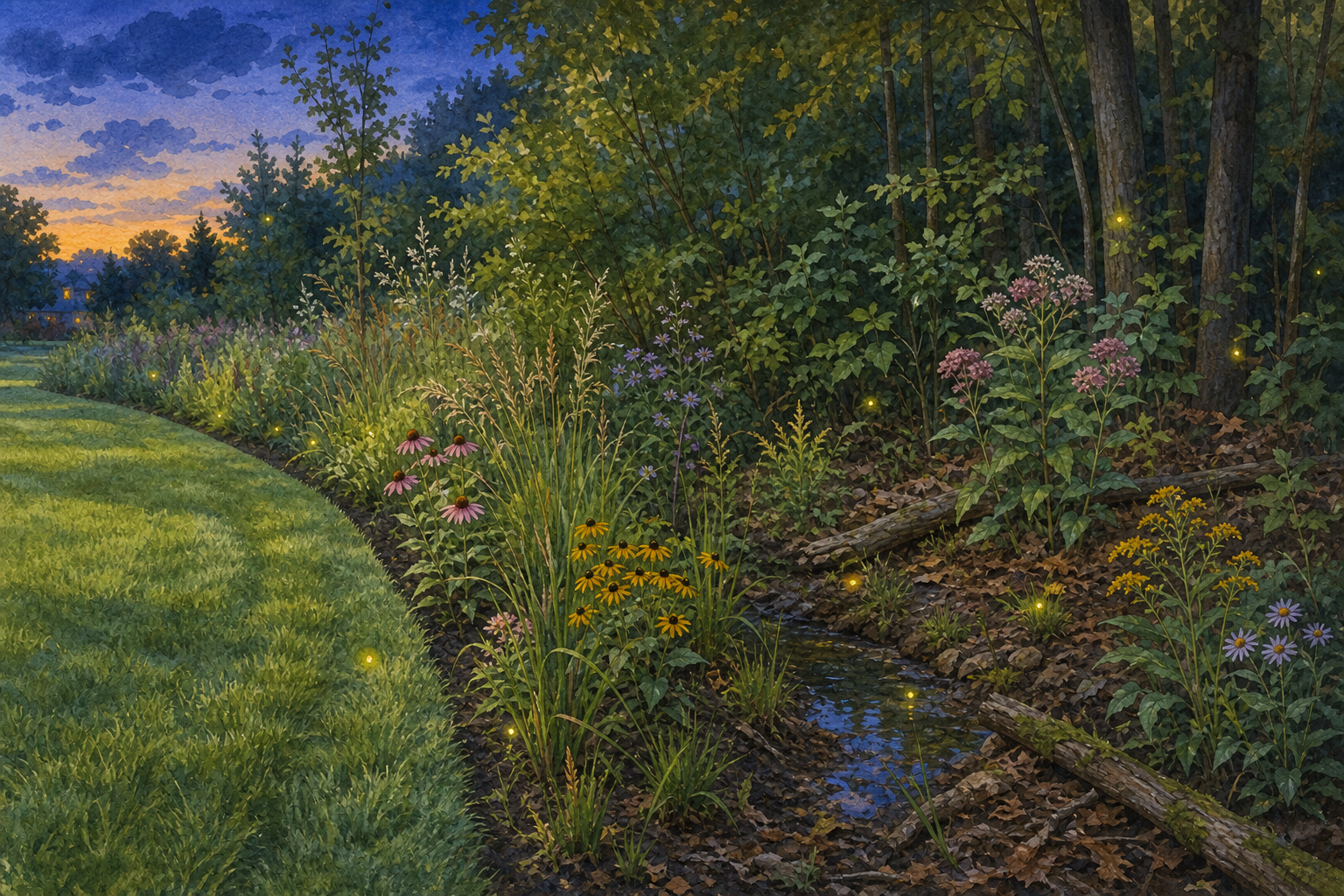
For a typical suburban Central Virginia yard, start with one 10-by-20-foot strip along a fence, tree line, ditch, back corner, or woodland edge.
From front to back:
- Mowed border: keep a clean 2–3 foot edge so the planting looks intentional.
- Grass/sedge layer: use native grasses or sedges for cover and structure.
- Flowering native perennials: add seasonal bloom and insect activity.
- Shrub or tree-edge layer: use native shrubs where space allows.
- Leaf litter/log pocket: tuck leaves and small logs behind the planting, not in the middle of the lawn.
- Dark zone: keep nearby lights off or shielded during summer evenings.
That is the whole concept: a tidy front edge with a softer, darker, damper nursery behind it.
Native plants for a Central Virginia lightning bug yard
Native plants are not a magic “firefly food” product. Their value is that they rebuild the living system around lightning bugs: soil cover, roots, shade, moisture, insects, and seasonal structure.
Virginia Cooperative Extension notes that native plants are adapted to local climate, moisture, soils, and wildlife relationships. For Mechanicsville, Hanover County, Richmond, and much of Central Virginia, start with adaptable Virginia natives from regional lists like Plant RVA Natives, then match them to your actual site.
Sunny meadow edge
Use these where you have six or more hours of sun and want a taller, wilder edge. Start with grasses for structure, then repeat flowering natives in groups so the habitat reads as designed instead of random.

Common milkweed
Asclepias syriaca
A bold milkweed for the back edge of a sunny Virginia habitat bed. It is not tidy, and that is the point: common milkweed makes room for monarch caterpillars, summer nectar, and the loose, layered cover that a firefly strip needs. Give it a place where spreading is welcome.

Swamp milkweed
Asclepias incarnata
The milkweed to start with if the yard has a rain-garden edge or a damp low spot. Swamp milkweed has the monarch value people want, but it behaves better than common milkweed in a visible home landscape. In Central Virginia clay, that matters.

Virginia mountain mint
Pycnanthemum virginianum
A workhorse pollinator plant with a clean look and a wild heart. Virginia mountain mint pulls in bees, wasps, butterflies, and tiny beneficial insects for weeks. It spreads, but in a meadow edge that is usually a feature, not a flaw.

Wild bergamot
Monarda fistulosa
Wild bergamot gives a Virginia meadow bed that loose lavender haze that feels alive rather than landscaped. It feeds bees, butterflies, and hummingbirds, but it needs air. Cram it into a humid corner and powdery mildew will probably show up.

Wrinkleleaf goldenrod
Solidago rugosa
Goldenrod is the fall fuel station. Wrinkleleaf goldenrod fits Central Virginia meadow edges well, especially where you want late nectar without pretending the garden is finished in August. It does not cause hay fever; ragweed gets that blame.

New England aster
Symphyotrichum novae-angliae
Aster is what keeps a pollinator bed open late. New England aster brings purple fall flowers, migrating monarch fuel, and seed for birds, but it is tall enough to need a real place in the plan. Put it behind shorter plants or cut it back in June.

Black-eyed Susan
Rudbeckia hirta
Black-eyed Susan is the easy first win. It gives a new habitat bed color fast while slower perennials settle in. In a Central Virginia yard, treat it as a cheerful self-seeder rather than a forever clump.
Part shade / woodland edge
Use these along tree lines, fence edges, and filtered shade where leaf litter, shrub cover, and cooler soil can do more habitat work than lawn.

Spicebush
Lindera benzoin
Spicebush is one of the best shrubs for making a shady Virginia edge feel intentional. It flowers early, feeds spicebush swallowtail caterpillars, and gives birds red fruit if you plant a female with a male nearby.

Virginia sweetspire
Itea virginica
A polished native shrub for the place where lawn drops into shade or a rain garden. Virginia sweetspire has fragrant spring flowers, good fall color, and enough suckering habit to hold a damp edge without looking messy.

Eastern columbine
Aquilegia canadensis
Eastern columbine is a small spring spark for the woodland edge. It is not a heavy structural plant, but it earns its space by feeding hummingbirds and early pollinators before the summer meadow plants take over.

Blue mistflower
Conoclinium coelestinum
Blue mistflower is beautiful and a little pushy. In the right Central Virginia spot, a moist edge where it can make a colony, that is exactly what you want. The late blue flowers bring butterflies when the garden starts to look tired.

White wood aster
Eurybia divaricata
White wood aster is the quiet fix for dry shade. It threads through a woodland edge, flowers late, and keeps the shady side of a firefly strip from turning into mulch and nothing else.
Damp or rain-garden edge
Use these where water naturally collects or soil stays moist. The goal is planted, living soil that soaks water in — not a stagnant mosquito puddle.

Buttonbush
Cephalanthus occidentalis
Buttonbush belongs in the wettest part of the plan. The white globe flowers are a pollinator magnet, and the shrub gives a ditch, pond edge, or rain-garden corner the height a flat planting often lacks. Do not squeeze it into a tiny bed.

Cardinal flower
Lobelia cardinalis
Cardinal flower is the red flag in a damp Virginia habitat strip. It wants moisture, rewards it with hummingbirds, and often behaves like a short-lived perennial that moves by seed instead of staying politely in one exact spot.

Joe-Pye weed
Eutrochium purpureum
Joe-Pye weed is not subtle. Use it where the firefly strip needs height, late-summer nectar, and a plant that can visually hold its own against shrubs and grasses. In a small yard, put it in the back and consider cutting it back in June.

Soft rush
Juncus effusus
Soft rush is the practical plant for the wet problem spot. It gives a rain garden or ditch edge clean vertical texture, holds soil, and does not ask for much once its feet are wet. It is not a dry-border plant.
Swamp milkweed
Asclepias incarnata
The milkweed to start with if the yard has a rain-garden edge or a damp low spot. Swamp milkweed has the monarch value people want, but it behaves better than common milkweed in a visible home landscape. In Central Virginia clay, that matters.
Grasses, sedges, and ground layer
This is the underrated layer. It gives cover, holds soil, and makes the habitat feel like habitat instead of just a flower bed.

Little bluestem
Schizachyrium scoparium
Little bluestem is the easiest grass to love in a sunny Virginia habitat strip. It brings upright summer texture, copper winter color, bird seed, and cover at ground level without needing rich soil or irrigation.

Switchgrass
Panicum virgatum
Switchgrass is the tall structural grass for Central Virginia meadows, swales, and rain-garden edges. It can handle more moisture than little bluestem and gives birds, insects, and the whole bed a place to disappear into.

Virginia wildrye
Elymus virginicus
Virginia wildrye gives the habitat strip an early-season grass layer before warm-season grasses wake up. It fits woodland edges, moist meadows, and part-shade transitions where little bluestem would sulk.

Pennsylvania sedge
Carex pensylvanica
Pennsylvania sedge is the lawn alternative for shade where turf gets thin. It makes a low, fine-textured layer under shrubs and along woodland edges, exactly the kind of cool cover that makes a firefly corner feel less exposed.

River oats
Chasmanthium latifolium
River oats is one of the best grasses for shade, especially where the soil stays a little damp. The dangling seed heads look great, but they also seed around. Use it where movement is welcome or be ready to edit seedlings.
Need help choosing plants for your actual yard? Start with Smart Lawn Guide plants and keep the first planting small enough that you can maintain it.
What to do this weekend, before buying anything
If you want a first slice before spending money, do this:
- Walk the property at dusk and mark where lightning bugs already flash.
- Pick one “dark zone” where outdoor lights will stay off during summer evenings.
- Choose one 10-by-20-foot edge that will be mowed less often.
- Stop spraying that zone entirely.
- Move leaves into shrub/tree edges instead of bagging them.
- Add one small brush/log corner where it looks intentional, not messy.
- Mow a clean border around the habitat strip so the wildness reads as designed.
- Record what you see once or twice a week.
A tiny observation log is enough:
| Date | Time | Weather | Zone watched | Lightning bug activity |
|---|---|---|---|---|
| June 8 | 8:45 PM | Warm, humid | Back fence / oak edge | 12–20 flashes in 5 minutes |
| June 15 | 8:50 PM | Dry, cooler | Same zone | 3–5 flashes in 5 minutes |
That is how you learn whether the yard already has a firefly pocket worth protecting.
A simple 30 / 60 / 90 day plan
| Timing | What to do | Goal |
|---|---|---|
| First 30 days | Map dusk activity, turn down lights, stop spraying, set mowing boundaries, leave some leaf litter, and identify damp edges. | Protect what is already there without spending money. |
| Days 30–60 | Add a small number of native grasses, sedges, flowers, and shrubs matched to the site. | Plant structure without overbuying. |
| Days 60–90 | Watch activity, note what stays damp, expand only where maintenance still feels easy, and add fall bloomers like goldenrod or asters if needed. | Turn one good habitat strip into a repeatable plan. |
Do not overbuy. A small, maintained strip beats a giant neglected project.
Common Virginia yard mistakes that hurt lightning bugs
Avoid these if the goal is more lightning bugs:
- installing bright white landscape lighting through every bed edge
- using bug zappers as a “mosquito solution”
- broadcasting insecticides across the whole lawn
- treating every shrub and foundation bed for mosquitoes on a schedule
- bagging every leaf in fall instead of leaving some under shrubs and trees
- mowing drainage swales short every week
- replacing damp living edges with rock, fabric, and sterile mulch
- creating stagnant buckets or water features that breed mosquitoes
- buying random wildflower mixes without checking whether the species are native to Virginia
Habitat tools worth considering
The best firefly habitat product is not a product. It is the decision to keep one part of the yard darker, softer, damper, and less chemically disturbed.
If this page ever includes store links, they should stay boring and useful:
| Category | What to look for | Why it belongs | Avoid |
|---|---|---|---|
| Rain gauge / soil moisture tools | Simple, non-gimmicky measurement tools | Helps identify damp habitat zones without guessing | Smart gadgets that overcomplicate a small yard project |
| Soil test kits | Clear instructions and useful pH / nutrient info | Helps match native plants to actual soil conditions | Treating a soil test as permission to over-fertilize |
| Warm, shielded lighting | Warm color, motion sensor or timer, downward shielding; DarkSky-approved if available | Supports firefly communication by reducing unnecessary light | Cool-white dusk-to-dawn floodlights |
| Leaf / compost tools | Compost bin, leaf corral, hand rake, edging tools | Makes leaf litter and clean borders look intentional | Plastic landscape fabric and sterile rock mulch |
| BTI mosquito dunks or bits | EPA-registered BTI products; OMRI Listed if available | Only for unavoidable standing water, rain barrels, or containers | Broadcast mosquito sprays, foggers, zappers, or yard-wide insecticide plans |
| Books and field guides | Virginia native plant or firefly guides from credible publishers | Helps homeowners learn before buying plants | Random seed mixes labeled “wildflower” without Virginia provenance |
Any live product link should have clear affiliate disclosure and only make claims we can verify from the manufacturer, label, EPA registration, OMRI listing, DarkSky listing, or product page. Five trusted links are better than twenty sketchy ones.
Avoid bug zappers, broad mosquito sprays, outdoor UV traps, routine perimeter insecticide subscriptions, and generic wildflower seed mixes sold as “firefly habitat.” They may monetize a lawn site, but they undercut the native habitat message.
For plants and seeds, the better direction is local Virginia-grown native plants, pickup, delivery, and small habitat kits.
Plants and habitat kits coming soon
We are planning a small local store for Mechanicsville / Hanover / Central Virginia yards, built around native plants and practical habitat kits instead of generic lawn products.
The first version could include:
- 10-by-20-foot Firefly Starter Kit — native grasses/sedges, flowering perennials, and one clean layout plan.
- Damp Edge / Swale Kit — plants for low, moist areas that should soak in water instead of holding stagnant mosquito water.
- Part-Shade Woodland Edge Kit — shrubs, sedges, and ground-layer plants for tree lines and fence edges.
- No-Spray Habitat Sign / Marker — a simple way to mark the protected zone.
- Seasonal refill packs — asters, goldenrods, mountain mint, sedges, and other natives based on availability.
Once the Stripe store is live, plants can be ordered for local pickup or local delivery / install support. Delivery or hands-on placement help will be charged at $20 per hour in addition to the plant cost, with the final plant list approved before anything is purchased or scheduled.
Until then, this page is the approval plan: choose the first zone, confirm the no-spray / low-light / low-mow rules, then buy only what fits the site.
Mechanicsville firefly habitat consult
For local yards, the most useful service is a small habitat audit, not a full landscape design package.
What the consult would include
- Light audit: which lights to turn off, shield, warm up, put on motion sensors, or aim downward.
- Mowing map: where to keep a clean edge and where to let the yard breathe.
- No-spray plan: how to protect the habitat zone while avoiding mosquito problems.
- Native plant starter list: matched to sun, shade, moisture, clay, deer pressure, and maintenance tolerance.
- 10-by-20-foot first slice: one small habitat strip to approve before buying plants.
- 30 / 60 / 90 day plan: what to do now, what to plant later, and what to observe before expanding.
Possible formats:
| Consult type | Best for | Deliverable |
|---|---|---|
| Photo / map review | Homeowners who want a quick first opinion | Annotated zone notes, starter plant list, and first-slice checklist |
| Mechanicsville-area yard walk | Local yards within practical driving distance | On-site light/mowing/habitat audit plus 30/60/90 plan |
| Plant pickup / placement support | Approved projects ready to install | Plant order, pickup or delivery, and $20/hr placement support plus plant cost |
This should stay small and local at first. The promise is not “instant fireflies.” The promise is a better yard system: darker nights, fewer chemicals, better native structure, and one habitat strip that still looks intentional.
Why Virginia is good lightning bug country
Virginia has many of the ingredients fireflies like: humid summer nights, wooded edges, creeks, ditches, meadows, older neighborhoods, leaf litter, and damp soil.
The problem is that modern yard habits remove those ingredients: brighter lights, shorter mowing, cleaner edges, fewer leaves, and more routine sprays.
A yard does not have to become wild everywhere. It needs one protected place where the old ingredients can overlap again.
Local Central Virginia resources worth using
Use these when you want local plant lists, conservation guidance, or a place to see native planting ideas in person.
- Plant RVA Natives guide — the core regional native plant guide for Hanover, Richmond, Henrico, Chesterfield, Goochland, Powhatan, New Kent, Charles City, Cumberland, and Amelia.
- Plant Virginia Natives — statewide campaign hub for Virginia native plant regions and education.
- Virginia Department of Conservation and Recreation native plant resources — state-level native plant guidance for conservation, restoration, and landscaping.
- Virginia Cooperative Extension lawn and garden resources — soil, garden, Master Gardener, and horticulture guidance from Virginia Tech / VCE.
- Virginia Cooperative Extension Master Gardener program — statewide education network and local help pathway.
- Hanover Master Gardeners — local horticulture and environmental education connected to Hanover’s VCE work.
- Hanover Master Gardeners Butterfly Garden at Pole Green Park — nearby pollinator demonstration inspiration.
- Hanover County Conservation for Homeowners — local conservation, stormwater, riparian buffer, wildlife habitat, and VCAP context.
- Hanover-Caroline Soil and Water Conservation District — local conservation district for erosion, runoff, and land stewardship programs.
- Lewis Ginter Botanical Garden native plantings — Richmond-area inspiration for designed native plant communities.
- Lewis Ginter Morton Native Plant Garden — a local place to see native plants arranged as a real garden, not just a plant list.
- Xerces Society firefly conservation guidelines — the strongest practical firefly conservation source.
- Firefly Atlas conservation guidance — homeowner-friendly firefly conservation actions and community science.
Frequently asked questions
When is lightning bug season in Central Virginia?
Lightning bug activity usually begins on warm, humid late-spring evenings and can continue through summer. Exact timing depends on rainfall, temperature, mowing, lighting, and species.
Do lightning bugs help the garden?
Firefly larvae can feed on soft-bodied invertebrates such as snails, slugs, and worms. Their bigger value is that they are a visible sign of a healthier, less chemically disturbed yard.
Do mosquito sprays kill lightning bugs?
Broad-spectrum mosquito sprays can harm many non-target insects. The risk is highest when spraying shrubs, lawn edges, damp areas, and leaf-litter zones where fireflies or their prey may be living.
Do I need a pond to attract fireflies?
No. Moist soil, damp leaf litter, planted swales, rain-garden edges, shaded low spots, and woodland edges are usually more practical than installing permanent standing water.
Should I buy fireflies and release them?
No. Focus on habitat. Releasing purchased insects is not a reliable conservation strategy and does not fix the underlying problem if the yard is too bright, too dry, too mowed, or too sprayed.
Can an HOA yard still support lightning bugs?
Yes. Use clean edges, intentional plant masses, maintained paths, darker lighting, and no-spray zones. A firefly habitat can look designed instead of neglected.
The first approved slice
Before buying plants, approve this small no-purchase experiment:
For one summer month, create a no-spray, low-mow, low-light habitat edge in the part of the yard where lightning bugs already appear. Keep the border mowed clean, leave leaf litter/log shelter in the back of the strip, and record firefly activity at dusk once or twice a week.
If that feels good and looks acceptable, then add the native plant layer.
The principle is simple: make part of the yard darker, softer, damper, more native, and less chemically disturbed. That is how a lawn starts becoming a lightning bug habitat again.